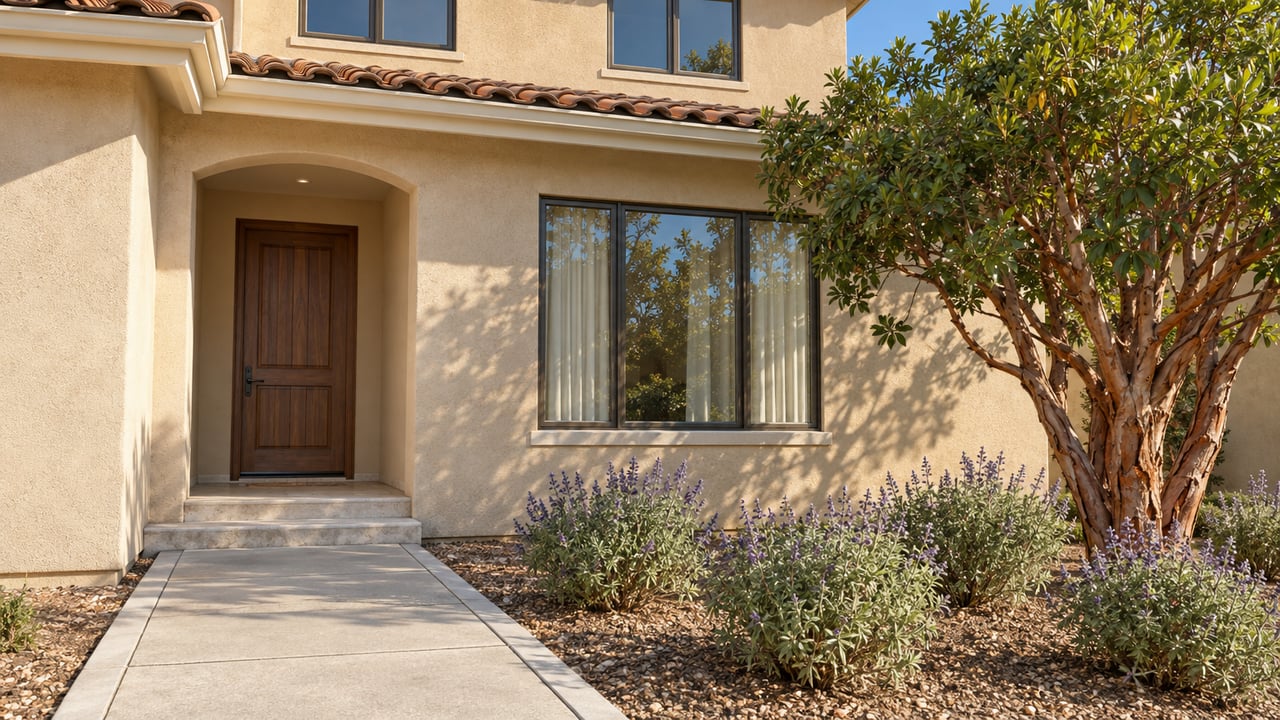
The Second Tax Line on Santa Paula's Newest Homes
October 15, 2026
October 15, 2026
Santa Paula's August 2026 single-family median was the lowest in Ventura County. The newest homes in town are listed for less than that median. A buyer who puts those two numbers side by side still won't know the yearly cost of either house. That cost depends on a set of special taxes the City of Santa Paula levies on Harvest at Limoneira parcels. The largest of them is scaled to home size, goes up 2% every July 1, and can last as long as a 30-year mortgage and beyond.
The two prices come from different sources. In August 2026, Santa Paula's median was $712,000, based on nine single-family sales, according to the Ventura County Star. The countywide median that month was $925,000, which puts Santa Paula about $213,000 below the county. Lennar's current inventory page for Harvest lists 55 available homes. The lowest was a 1,474-square-foot Grove plan at $589,990, and the highest was a 3,977-square-foot Laurel plan at $1,159,990.
The Star took its figures from the California Association of Realtors, and the article says the data covers "existing single-family homes." A builder's first sale of a new house is not an existing-home sale. So the $712,000 median comes from resale homes in older parts of town, and it rests on only nine sales. It doesn't measure Harvest's product.
That matters because Harvest is now a large part of Santa Paula's housing. The Ventura County Star reported in February 2026 that the 2,050-unit project is expected to be fully built by 2030, according to Limoneira Co. CEO Harold Edwards. The project broke ground in 2017 under the name East Area One. Limoneira's fiscal third-quarter release on September 9, 2026 said lot sales covering 554 residential units closed in April 2024, which sold out Phase 2. It also said home sales were underway after five new Phase 2 neighborhoods opened in February 2026. Lennar added two more collections, Grove and Walnut, in April 2026. Santa Paula's published median and Santa Paula's new-construction prices describe two separate markets.
Lennar's page for the Walnut collection shows two fees: approximate HOA fees of $335.12 and an "approximate tax rate" of 1.82%. The page doesn't say how often the HOA fee is billed, and it doesn't split the 1.82% into its parts.
Older parts of town show a lower rate. Ventura County's FY 2025-26 tax-rate book for Santa Paula starts with the 1% general levy and adds voter-approved school and college bond rates. That gives totals such as 1.1065% in tax rate area 04001 and 1.1269% in area 04002. Each parcel's tax rate area sets its exact rate, but the examples cluster around 1.1%.
Applying each rate to its price gives a rough comparison:
| Scenario | Price | Rate applied | Approximate annual tax |
|---|---|---|---|
| Resale at the August 2026 median | $712,000 | 1.1065% | about $7,880 |
| Lowest-priced Harvest inventory home | $589,990 | 1.82% | about $10,740 |
| Same Harvest home at the older-area rate | $589,990 | 1.1065% | about $6,530 |
These figures are arithmetic from published rates and prices. They are not anyone's tax bill. The Harvest home costs about $122,000 less, but at Lennar's blended rate its estimated yearly tax is close to $2,900 higher than the median resale. That doesn't count the HOA fee. The gap between the second and third rows, about $4,200, is roughly the size of the special taxes described below.
The 1.82% includes special taxes from community facilities districts, often called Mello-Roos districts. They fund the roads, parks and services a new community needs. The city's records show Harvest Community Facilities District No. 1 was formed on November 21, 2016, with three improvement areas, A, B and C, matching the expected phases of construction. Harvest CFD No. 2 is a separate district.
The Ventura County Star covered this when the districts were proposed. In 2019 it reported that two special taxes would add $2,531 to $4,481 a year to a starting Harvest tax bill, and that the charges would rise every year. At that point the only landowners able to vote were two Limoneira entities and KB Home. Those are proposed amounts from 2019, not current bills. The current figures come from the county and from bond documents.
The county auditor-controller's FY 2025-26 direct-assessment record shows $2,150,715.10 levied for Harvest CFD No. 1, Improvement Area A, across 613 parcels. It also shows $188,547.32 for Harvest CFD No. 2 across 613 parcels. That works out to averages of about $3,510 and $308 per parcel. The averages hide differences between homes, because the Area A tax is set by square footage.
The city's 2022 bond official statement lists the Area A facilities tax, called Special Tax A, by home size for FY 2021-22. It also says the tax rises 2% each July 1, beginning July 1, 2019. The right column below applies four of those increases. It shows the scheduled amounts for FY 2025-26 and is an illustration, not a published current table.
| Home size | FY 2021-22 assigned tax | FY 2025-26, calculated at 2% a year |
|---|---|---|
| Under 1,750 sq ft | $2,361 | about $2,556 |
| 1,750 to 1,950 sq ft | $2,734 | about $2,959 |
| 1,951 to 2,150 sq ft | $2,897 | about $3,136 |
| 2,151 to 2,350 sq ft | $3,080 | about $3,334 |
| 2,351 to 2,550 sq ft | $3,556 | about $3,849 |
| 2,551 to 2,750 sq ft | $3,715 | about $4,021 |
| 2,751 to 2,950 sq ft | $4,005 | about $4,335 |
| 2,951 to 3,150 sq ft | $4,206 | about $4,553 |
| Over 3,150 sq ft | $4,406 | about $4,769 |
Three other facts from the same document shape the long-term cost. Special Tax A can be levied for up to 40 fiscal years starting in FY 2019-20, which means as late as FY 2058-59. A separate services tax, Special Tax B, was $97.66 in the sample FY 2021-22 bill for a 2,189-square-foot home, and its yearly increase ranges from 2% to 6%. Harvest CFD 2 appears on that same sample bill as another fixed-rate charge.
Ordinary California property tax mostly follows the purchase price. Special Tax A works differently. Its maximum is set by the size of the house and climbs on a schedule, no matter what the home sold for. Two buyers of same-size Area A homes, one who paid more and one who paid less, face the same scheduled maximum.
The table covers Improvement Area A, the earlier phase that is already bonded and taxed. Lennar is building in Areas B and C. A City of Santa Paula memo dated February 18, 2026 says bonds have been issued and taxes levied only in Area A. It describes Lennar as "a home builder expected to build homes within Improvement Areas B and C."
The memo asked the council to adopt resolutions amending the rate and method of the special tax for Areas B and C. This followed a development agreement amendment the council approved on January 14, 2026. Under the change, the developers agreed to let part of the facilities portion of the B and C tax go toward long-term upkeep of the Sports Park. That park is the 37-acre Santa Paula Creek Regional Sports Park, which opened in May 2025.
So the special tax for a Grove or Walnut home comes from a newly amended schedule that isn't in the Area A table above. Part of it pays for maintaining a specific public amenity. The Area A figures and the county averages show the scale of these taxes. The exact amount for a home being sold today depends on the amended B and C documents and that parcel's disclosure.
The money has a purpose. Lennar's April 2026 announcement lists The Farmhouse clubhouse, a pool and spa, fitness and yoga spaces, sport courts, a dog park, barbecue areas, a tot lot and a community garden. A January 2024 city presentation described The Farmhouse and several Phase I parks as finished. It also put Phase III at 489 homes, with land development planned to start in 2026. Some of these amenities are funded by the HOA, some by the special taxes, and the Sports Park is now partly tied to the amended B and C levy. A comparison with a resale home that has none of these features needs to include those yearly costs in the price.
Is Santa Paula still the lowest-priced city in Ventura County? For existing single-family homes in August 2026, yes. Its $712,000 median, based on nine sales, was the lowest in the county that month. That figure doesn't include new-construction sales at Harvest.
Does the special tax end when the bonds are paid off? Under the official statement, Area A's Special Tax A can be levied for up to 40 fiscal years beginning FY 2019-20, and the actual yearly levy can't exceed each parcel's maximum. The services portions follow their own rules, and current schedules for those weren't available.
Where can I see the exact figure for a specific home? These documents carry the parcel-level numbers:
The 1.82% on the listing page is a useful starting estimate. The actual levy for a given parcel is in those documents.
Every Harvest purchase includes a special-tax schedule and a set of disclosures to review, and confirming those numbers is part of the transaction work Kirksey Realty handles for clients. If you're comparing a Harvest home with a resale home in older Santa Paula, we can put both annual costs side by side before you make an offer. Let's Connect.
This article is general information, not legal, tax or financial advice. Consult a qualified professional about your situation.
Stay up to date on the latest real estate trends.


I am committed to guiding you every step of the way—whether you're buying a home, selling a property, or securing a mortgage. Whatever your needs, I've got you covered.
2475 Townsgate Rd Ste 160 Westlake Village, CA 91361 Kirksey, Alyssa Rae Laurenti | CA DRE# 02095207